
Husam Shwei, presented the harsh realities of Gaza, the West Bank territories and the city of Hebron, especially since October 7, 2023.
Husam Shweiki is a Palestinian architect and urban planner who serves as the Head of Architecture at Hebron Municipality. He is also a member of Hebron’s Core Planning Team for the city’s 2023–2026 strategic development plan. In addition, he works as an EDGE Expert for EDGE Buildings, advising on sustainable and green building design in Palestine.
oOo
Palestine Case
Husam, presented the harsh realities of Gaza, the West Bank territories and the city of Hebron, especially since October 7, 2023.
Housing is a basic human need and should be affordable for all. Affordable housing enables decent housing, which improves health, productivity, and socio-economic development. But Palestine is a special case, as it remains under occupation, which creates conditions that are different from those of most countries.
GAZA
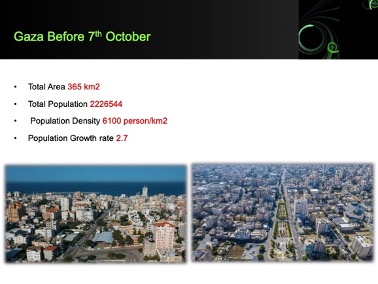
Before October 7, Gaza was a highly organized and extremely dense territory — about 365 square kilometers for more than 2 million people, or a density of more than 6,000 people per square kilometer, with a high growth rate of about 2.7 percent per year.
Despite political constraints and the blockade in place since 2005, limiting movement and access to resources, the population had adapted to harsh environmental and economic conditions: intermittent electricity, failing water systems, limited road infrastructure and severe restrictions on mobility, particularly when leaving Gaza or interacting with Palestinians in the West Bank.
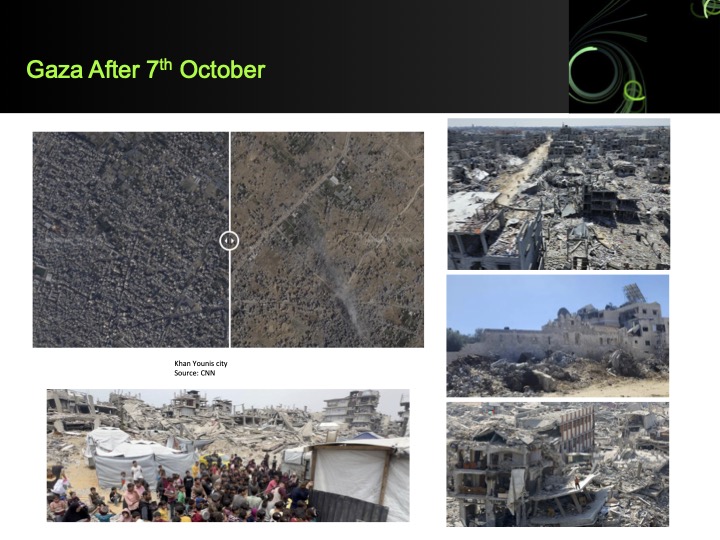
After October 7, the situation in Gaza became catastrophic. The media showed the extent of the destruction. On the humanitarian and housing front, more than 1.2 million people are now in need of emergency shelter, and around 320,000 homes have been completely destroyed.
With winter temperatures dropping below 10°C, many have only flimsy tents with no real protection. More than 80 per cent of the infrastructure, including homes, buildings, roads, water and sanitation systems, and cultural heritage sites, has been damaged. Gaza is now a destroyed city, with extremely limited means of survival.

The West Bank
The situation in the West Bank is different, as Israeli settlers reside there. The West Bank covers about 5,600 square kilometers and is home to nearly 3.3 million Palestinians in 11 governorates, alongside Israeli settlements.
Under the 1993 Oslo Accords, the West Bank was divided into Areas A, B and C: Area A is under Palestinian civil and security control, Area B is under Palestinian civilian but Israeli security control, and Area C — the largest, about 60 percent — is under full Israeli control.
On maps, Palestinian communities often appear as islands within a larger whole. Since 2010, more than 13,000 Palestinian structures have been demolished and more than 20,000 people displaced in the West Bank. There are about 20 settlement blocs in the West Bank, covering nearly 20 percent of Area C, with about 700,000 Israeli settlers occupying strategic locations — often near or around communities.
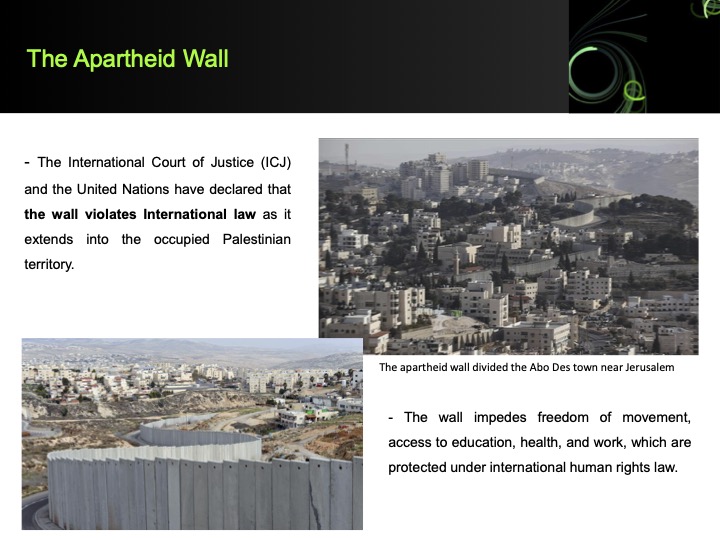
Another major constraint is the separation barrier — often referred to as the “apartheid wall” — that crosses territories and isolates communities; in areas like Abu Dis, near Jerusalem, the wall literally divides villages. Segregation was reinforced by road networks designed for the mobility of settlers.
East Jerusalem
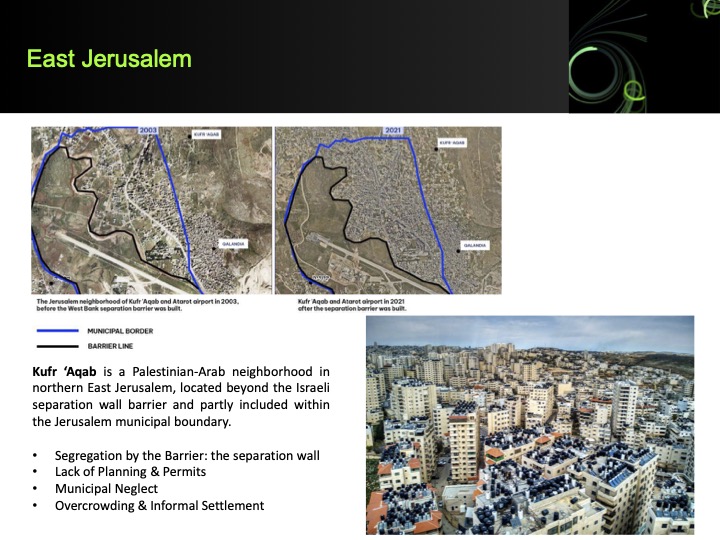
East Jerusalem is another special case. Some Palestinians have Israeli ID cards and can enter Jerusalem and other Israeli cities, but they face severe restrictions on construction. As a result, many are building in outlying villages such as Kufr Aqab, near Ramallah, which are growing rapidly but lack infrastructure, are overcrowded and take the form of informal settlements.
Hebron
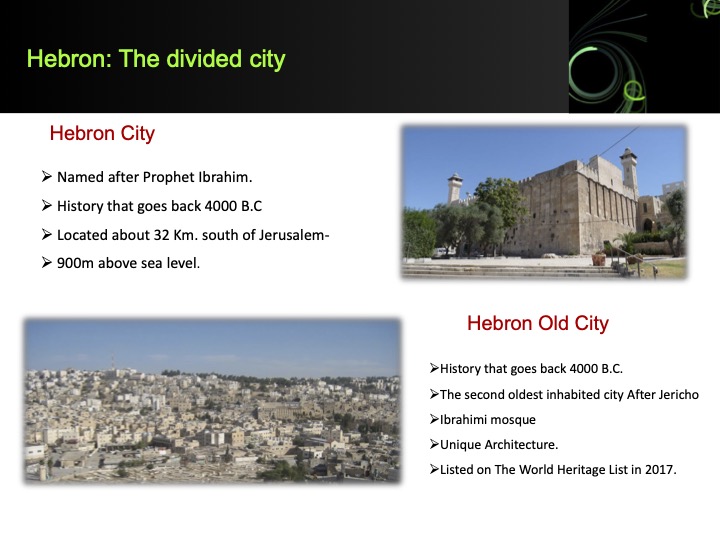
Hebron, the second largest city in Palestine, is located about 32 km south of Jerusalem. It is named after the Prophet Ibrahim and was listed as a UNESCO World Heritage Site in 2017.
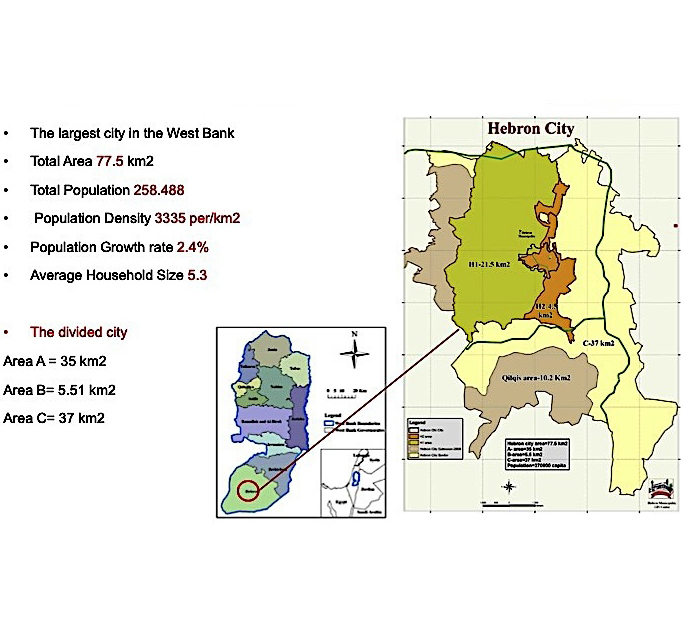
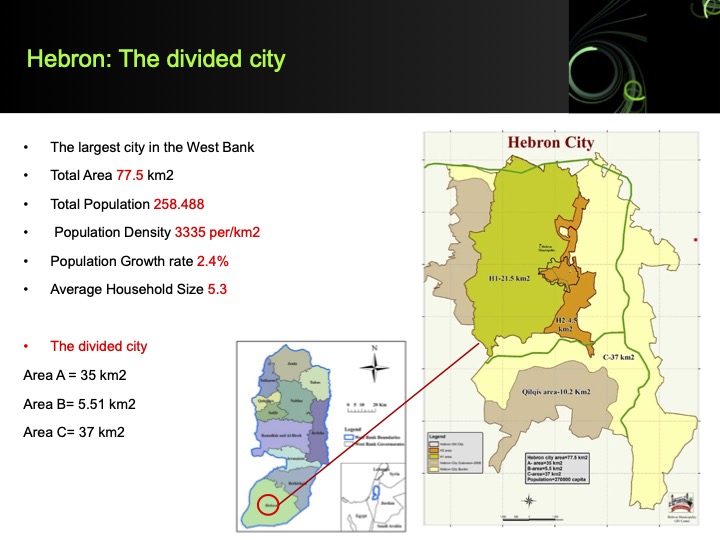
Hebron is uniquely divided, beyond Areas A, B, and C, into H1 and H2: H1 is under Palestinian civil control, while H2 is under Israeli control and includes the UNESCO-listed Old City.
Israeli settlements are located inside H2. The municipal territory of Hebron exceeds 77 km² and has about 258,000 inhabitants, with a density of more than 3,000 inhabitants per km².
A large part of municipal land is located in zone C. The maps show how Area C and the bypass roads divide Hebron into north and south and block eastward expansion, limiting urban development and housing growth.
The old city and its surroundings are heavily restricted, with numerous checkpoints restricting access and a significant presence of settlers nearby.
Large settlements such as Kiryat Arba and Givat Ha’ot are located near Hebron; some have been built on historic Palestinian buildings (e.g. the transformation of a former Palestinian school into a religious college), and major roads such as Shuhada Street have been closed to Palestinians while remaining open to settlers.
Market areas have been closed and replaced by settlements.
Showcasing two resilience projects in Hebron
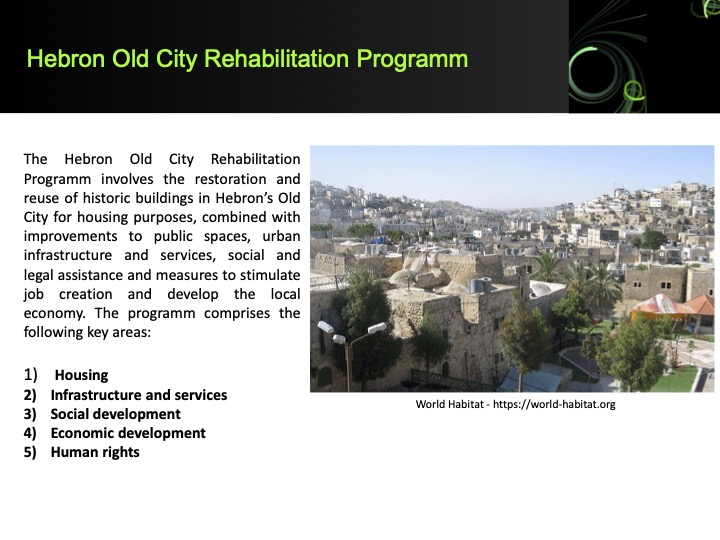
The first received the World Habitat Award in 2013
A Palestinian program to rehabilitate the Old City after the departure of residents following the Hebron agreement (which established the H1/H2 divide). A rehabilitation committee has restored traditional buildings and encouraged the return of residents and economic activities. The project has renovated more than 1,000 homes, benefiting approximately 6,000 people, while improving infrastructure, services and socio-economic conditions.
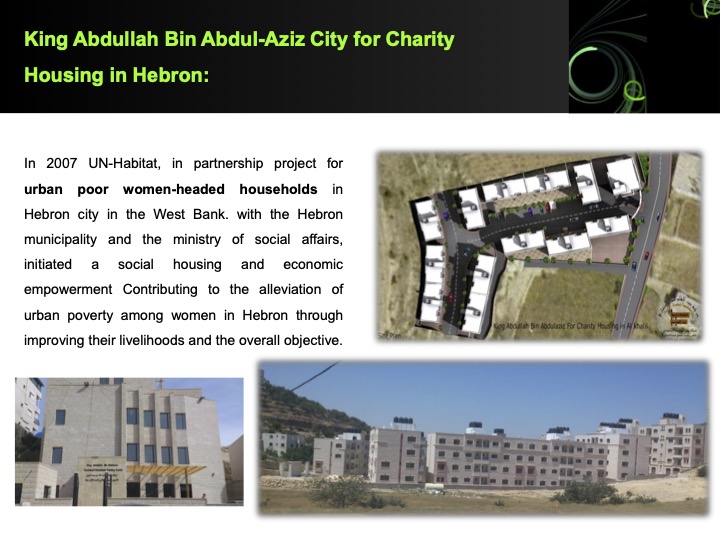
The second project is the King Abdullah bin Abdulaziz Charitable Housing City
In Hebron and built on municipal land to provide 100 housing units for poor female-headed households, with spaces dedicated to economic activities to support the livelihoods of the residents.
Housing needs and constraints
According to the Ministry of Public Works and Housing, Palestine needs more than 40,000 new housing units by 2030.
But parallel demolitions by the occupation — more than 13,000 buildings demolished since 2009 and more than 20,000 people displaced — create a cycle of construction by Palestinians followed by demolitions by Israeli authorities.
Political complexity adds to resource scarcity: Palestinians do not have full access to natural resources such as water and electricity, which are controlled by Israel. They are often banned from drilling wells and have to buy water from Israel, which controls the volumes.
The main challenges of housing in Palestine are:
- lengthy, complex and costly permit procedures, particularly in Area C and East Jerusalem;
- high land prices in areas where Palestinian expansion is limited;
- rising construction and infrastructure costs, linked to border controls and import restrictions;
- poor maintenance and housing of insufficient quality, rehabilitation being difficult under occupation.
-oOo-