
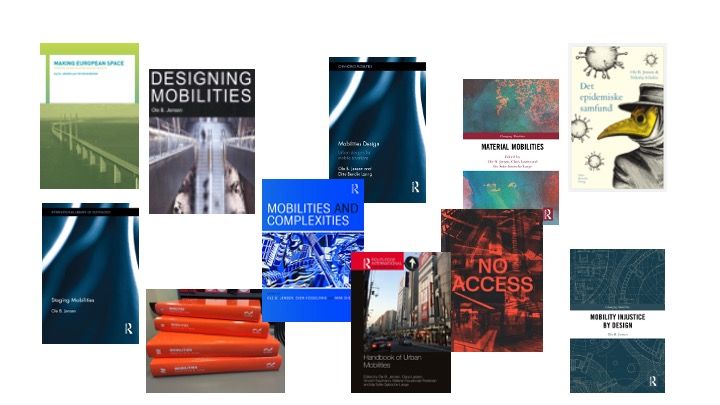
Professor Ole B. Jensen – Exclusionary design, mobility and justice
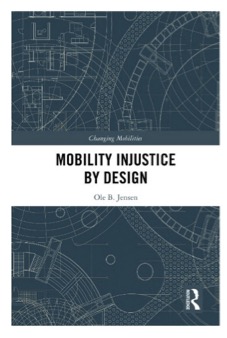
In this presentation, Professor Ole B. Jensen examined how urban design shapes everyday experiences of mobility, access and exclusion. Drawing on his book Mobility and Justice by Design, he explored the relationship between bodies, infrastructures and power, and showed that the built environment is never neutral. His approach combined sociology, ethnographic observation and critical design theory, with a particular focus on how urban spaces can restrict participation and make certain lives more difficult to sustain.
oOo
How design produces exclusion
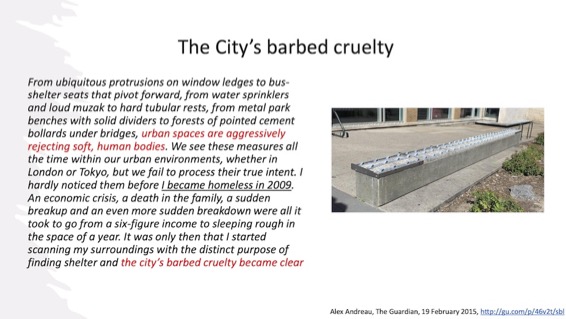
A central argument of the presentation was that design can exclude both intentionally and unintentionally. Jensen referred to benches, armrests, spikes and other devices placed in public spaces to prevent homeless people from resting or sleeping there. These are not neutral details of urban furniture, but deliberate interventions aimed at discouraging specific practices associated with specific groups. He also stressed that exclusion does not always result from hostile intention. Traffic systems, inaccessible stations, broken sidewalks or badly designed crossings can also marginalise people by making circulation difficult, unsafe or exhausting.
From homelessness to disability and ageing
Jensen organised his analysis around three empirical areas: homelessness, disability and ageing. In each case, he showed how mobility injustice is lived through the body. People experiencing homelessness described a constant atmosphere of rejection and displacement in the city. Disabled people, especially wheelchair users, often have to plan every journey in advance and remain vulnerable to the failure of lifts or other essential infrastructure. Older people may face uneven sidewalks, short pedestrian crossing times and urban environments that are increasingly difficult to navigate. Across these examples, the city appears not simply as a backdrop, but as an active producer of unequal conditions of movement and presence.
Why injustice must be made visible
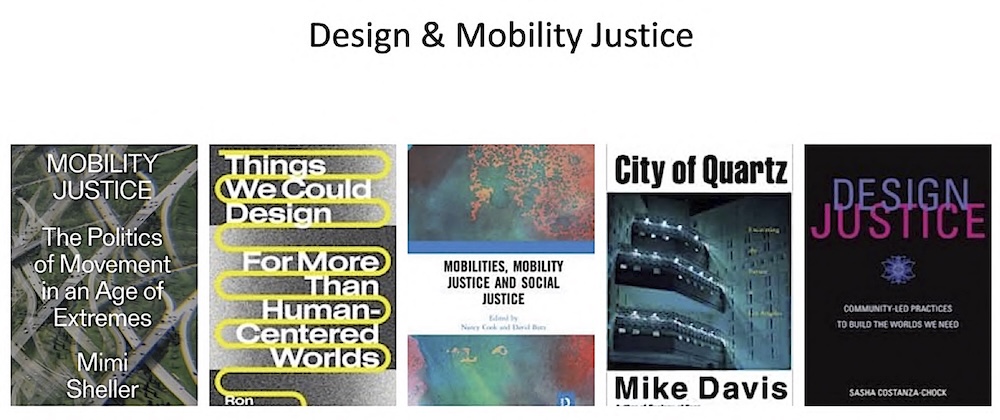
Another major point in the presentation was that injustice should be made public and understood as a material and emotional experience. Jensen argued that urban injustice is not only about rights, procedures or formal access. It is also about how people feel when the city tells them, through its spaces and objects, that they do not belong. This is why he moved from abstract discussions of justice toward a more grounded attention to injustice as it is actually lived. Because built environments are made, they can also be remade. For Jensen, this is where the ethical and transformative potential of design lies: in revealing, questioning and changing the norms embedded in urban space.
Q&A: from abstract justice to lived injustice
In the discussion, Jensen acknowledged that most of his examples came from Danish, European and North American contexts, and that broader cross-cultural comparison remains necessary. He also responded to comments about the importance of using the language of justice and injustice more explicitly in professional practice. Returning to his main argument, he explained that people rarely ask for justice in abstract terms; rather, they express how injustice is felt in their bodies and daily lives. The exchange also highlighted current challenges linked to housing pressure, gentrification, digitalisation and the declining willingness to share urban space with vulnerable groups.
-oOo-