
Husam Alwaer – The conditions for making local living a realistic response to contemporary urban crises.
Professor Husam AlWaer’s presentation explored whether living well locally can become a realistic response to contemporary urban crises. He situated the discussion within a context shaped by climate change, health inequalities, the housing crisis, the cost of living, changing patterns of work and the long-term effects of COVID. His intervention drew on a decade of work with governments, practitioners, policymakers and academics, and argued for a renewed understanding of neighbourhood planning centred on proximity, low-carbon lifestyles and human wellbeing.
oOo
Why local living matters in a time of crisis
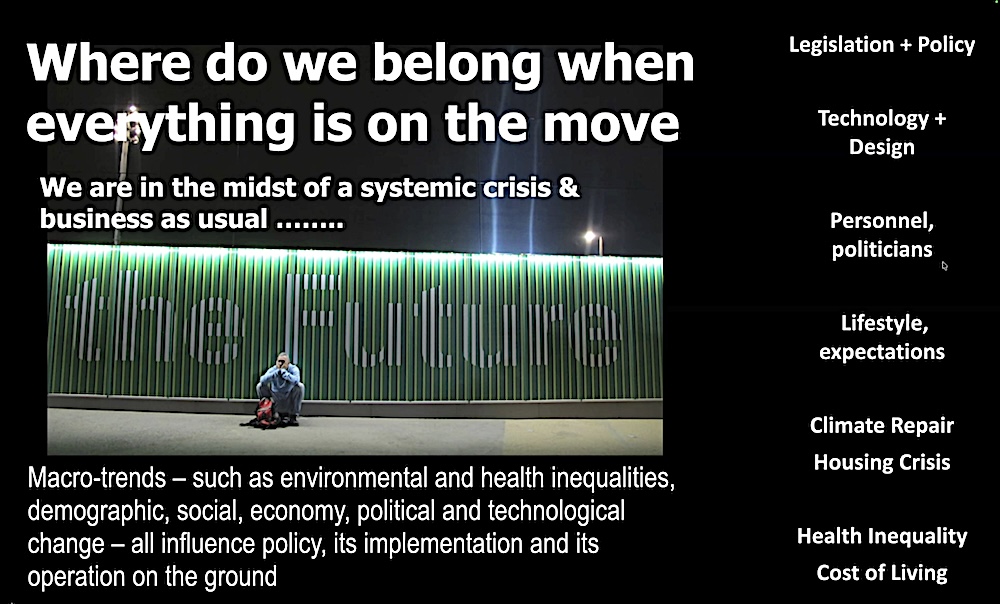
AlWaer explained that COVID and the post-COVID period revealed the importance of proximity, slowness and locality, especially in places where people had access to parks, public spaces, services, mixed housing and good transport. At the same time, deprived and peripheral neighbourhoods showed how unequal these conditions remain. This led him to argue that local living has become a key lens for addressing carbon reduction, healthier environments, hybrid work, mental and physical health, and broader questions of social resilience. He connected these concerns to ideas such as liveability, the soft city and the humanised city, all of which point toward more caring, comfortable and ecologically grounded urban environments.
From housing to connected neighbourhoods
A major argument in the talk was that housing alone does not make a neighbourhood. Local living requires compact urban form, mixed uses, the right density and a critical mass of people and activities. It also requires moving away from mono-functional zoning and from urban sprawl, both of which undermine everyday accessibility and increase dependence on the car. AlWaer contrasted cities that overinvest in the centre with cities such as Utrecht, Freiburg, Leipzig and Copenhagen, which seek to strengthen connected neighbourhoods across the wider urban territory. In this perspective, the city centre retains a role, but equity and quality of life depend on distributing opportunities, services and infrastructures more evenly.
Social infrastructure, proximity and everyday life
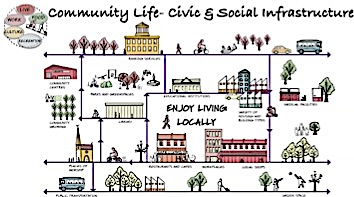
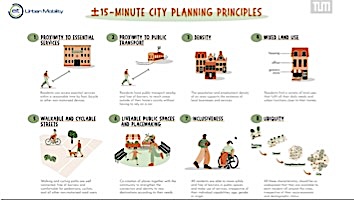
AlWaer also insisted on the importance of rethinking infrastructure. Beyond transport and technical networks, he emphasised the role of civic and social infrastructure as spaces where people meet, build relationships and support community life. Libraries, for example, are no longer just places for books; they can become multifunctional places of connection and opportunity. He linked this to the wider idea of the 20-minute neighbourhood, which is not simply about walking or cycling, but about combining access to essential services, public transport, mixed land use, liveability and inclusivity. In his view, urban form strongly influences behaviour: when the city is designed for cars, car use follows; when it is designed for active travel and proximity, different habits become possible.
Q&A: from the 15-minute city to the 20-minute neighbourhood
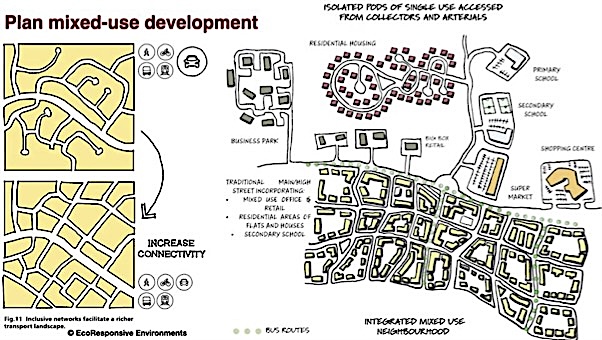
In the exchange after the presentation, AlWaer explained that the shift from the 15-minute city to the 20-minute neighbourhood reflects both practical and conceptual considerations. The 20-minute model corresponds more closely to realistic walking distances and recognises that not everything can be reached within ten or fifteen minutes. He also stressed that the exact number matters less than the broader ambition to create a new way of living locally. When asked for examples, he mentioned Broughty Ferry as a case of a very local neighbourhood and confirmed that even cities shaped by older planning models can still adapt to new urban concepts.
-oOo-